
- 47 Principal Investigators
- 10 Project partners
- 20 Partner institutions
- 22 Stakeholder organizations
NCCR CLIM+ and the new Center for Climate Extremes and Resilience in Swiss Society (CERESS) will unite expertise from both the natural and social sciences through truly innovative inter- and transdisciplinary research. Together, NCCR CLIM+ and CERESS will inform Swiss policymakers and the public about physical climate risks and develop adaptation solutions that account for societal trade-offs and co-benefits across key sectors. With its unique research consortium, NCCR CLIM+ will support Switzerland's effective transformation towards a more resilient and safer future.
About
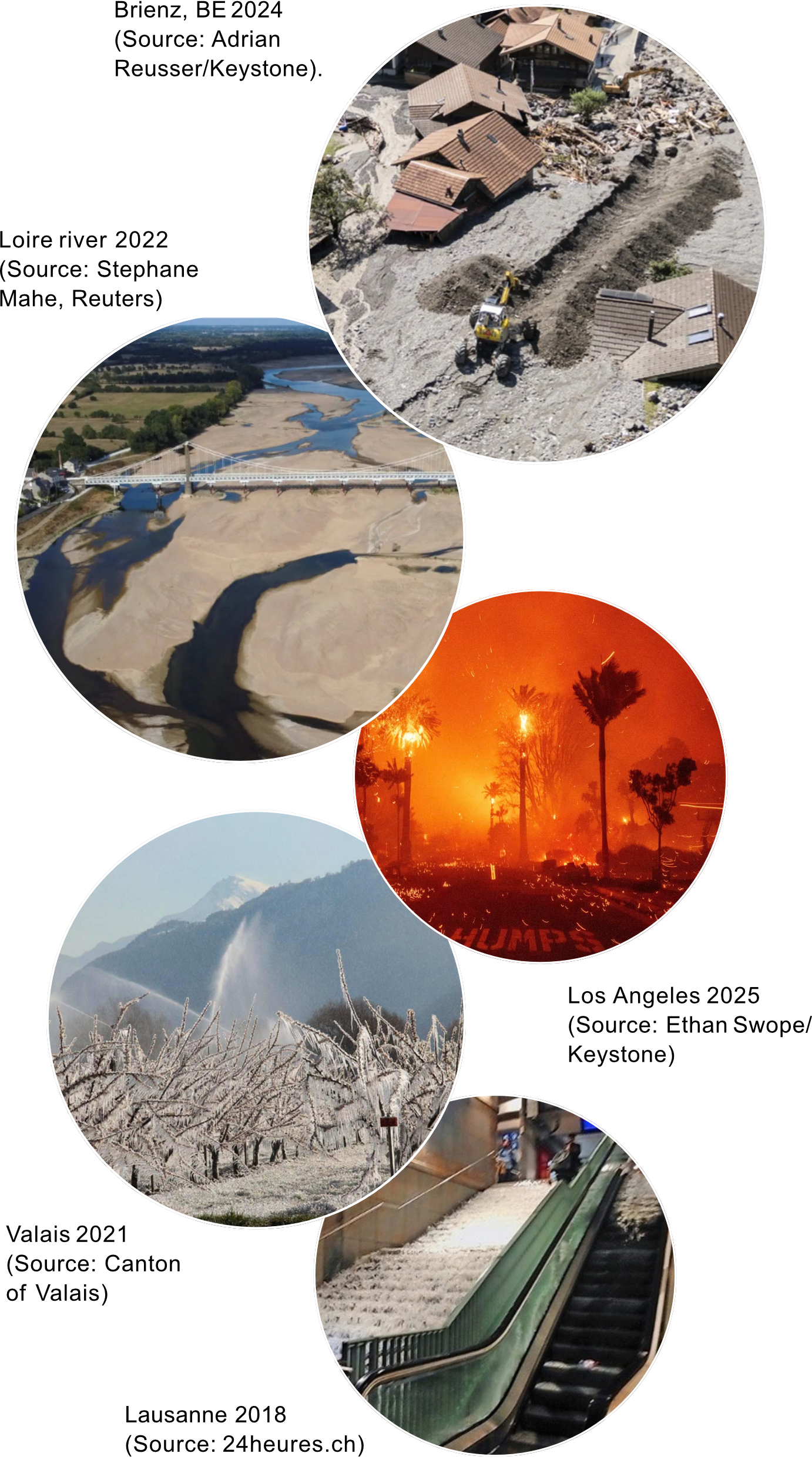
Recent devastating high-impact climate extremes in Switzerland and around
the world have highlighted the implications of increasing human-induced
climate change. Switzerland is strongly affected, with an observed warming
two times larger than mean global warming and with demonstrated rapid
changes in climate extremes, including heatwaves, droughts, and heavy
precipitation, as well as compound events.
In addition, climate disasters across the globe can have indirect but
pronounced impacts on Switzerland. They can, e.g., affect supply chains
and the global economy, in particular if extremes occur in multiple
regions concurrently. Failure to achieve the aims set under the Paris
Agreement would further amplify changes in climate extremes and increase
the risk of unprecedented events, causing long-term disruptions and
repeated societal crises.
NCCR CLIM+ will address emerging research questions on societal
transformation in the context of climate change mitigation and societal
resilience, in fields ranging from federalism and governance, economics,
ethics, and law, to climate communication and behavior changes.
In the context of amplifying changes in climate extremes, the
transformations necessary for climate change adaptation and mitigation
represent an enormous technical, political, and socio-economic challenge.
To tackle this challenge, NCCR CLIM+ will establish the first fully
interdisciplinary, Switzerland-wide climate research community, which
will interact with stakeholders ranging from public health to finance,
agriculture, and water management.
By pooling competence from leading Swiss research institutions across
multiple natural and social science disciplines, NCCR CLIM+ will combine
fundamental knowledge with transformational knowledge. This unique
vantage point allows it to make groundbreaking contributions to both the
understanding of climate change challenges and the development of
innovative solutions for adaptation and mitigation, while considering
interactions between climate change, ecosystems, and society.
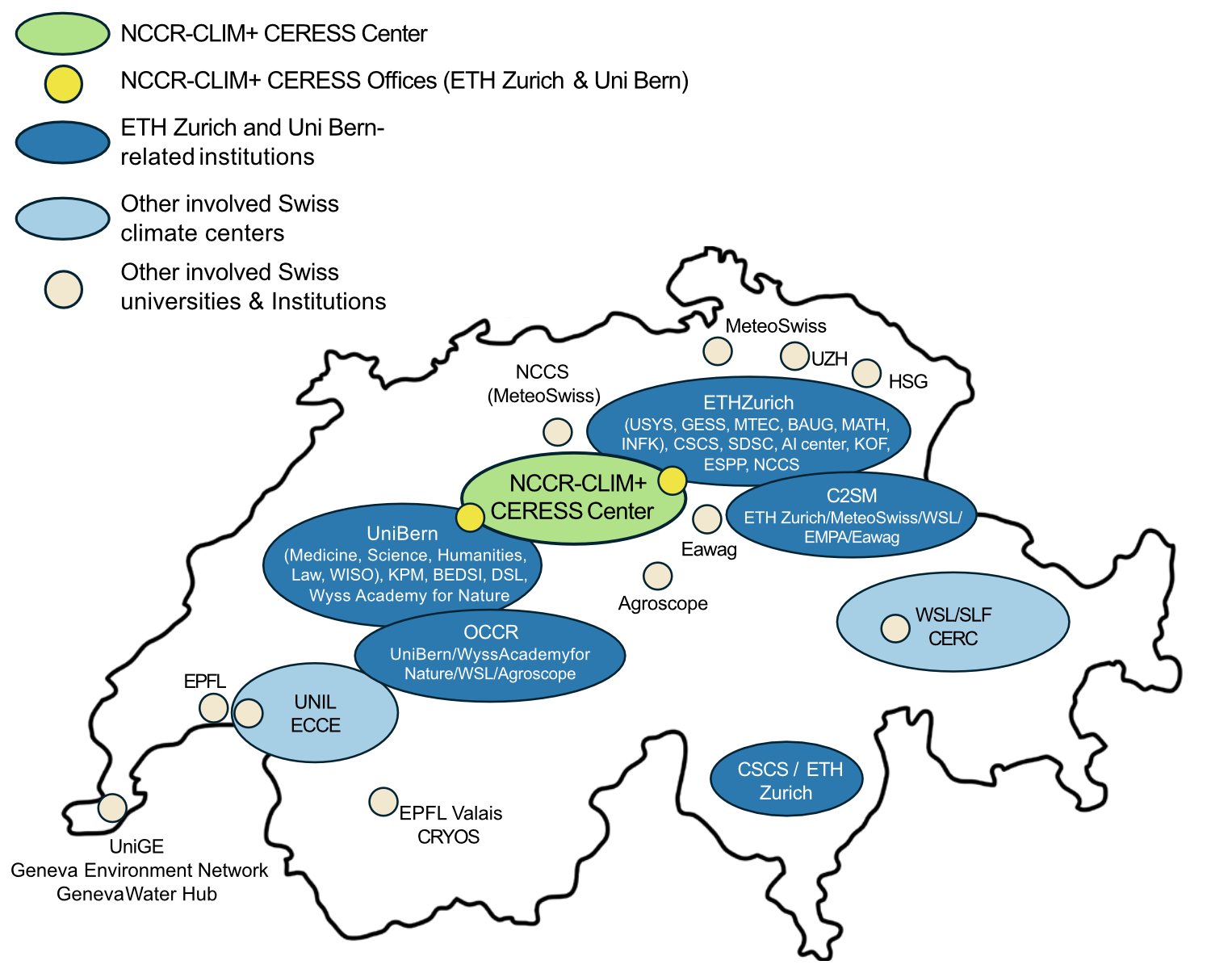 NCCR CLIM+ partners and the new Center for Climate
Extremes and Resilience in Swiss Society (CERESS)
NCCR CLIM+ partners and the new Center for Climate
Extremes and Resilience in Swiss Society (CERESS)
Under the lead of ETH Zurich and the University of Bern the newly founded Center for Climate Extremes and Resilience in Swiss Society (CERESS) will connect with numerous further universities and climate centers across Switzerland. CERESS will support nationwide research, co-design living labs, and produce actionable solutions, thus forming a new transdisciplinary nexus between science, society, practice, and politics.
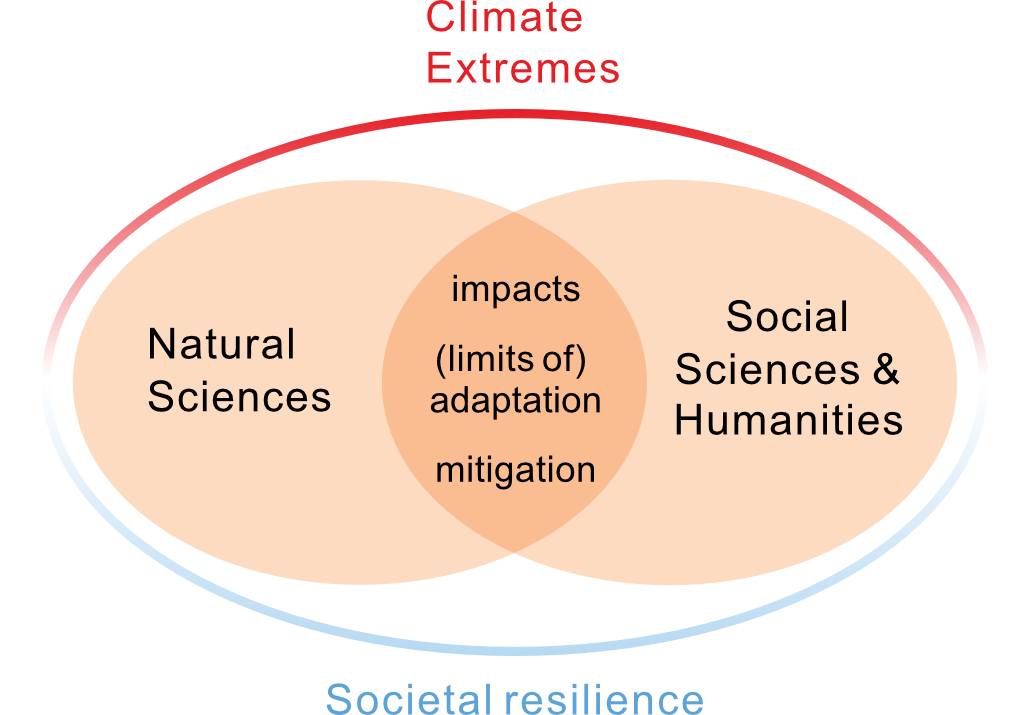 The unique interdisciplinarity of NCCR CLIM+
To facilitate cross-disciplinary communication and provide actionable
knowledge, NCCR CLIM+ will develop storylines of self-consistent plausible
futures encompassing the physical and social dimensions of extreme
climate outcomes. The storylines offer cross-disciplinary narratives that
allow researchers to carefully quantify and assess any co-benefits and
trade-offs of transformation to enable enhancement of societal resilience.
NCCR CLIM+ will pioneer novel approaches in physics-based and data-driven
climate modeling, leveraging artificial intelligence (AI) / machine
learning and modern statistical methods. It will make major contributions
to emerging climate research on compound extremes and “record-shattering”
high-impact low-likelihood events, and further the understanding of
potential impacts of global and regional tipping points (abrupt changes)
in Switzerland and Europe.
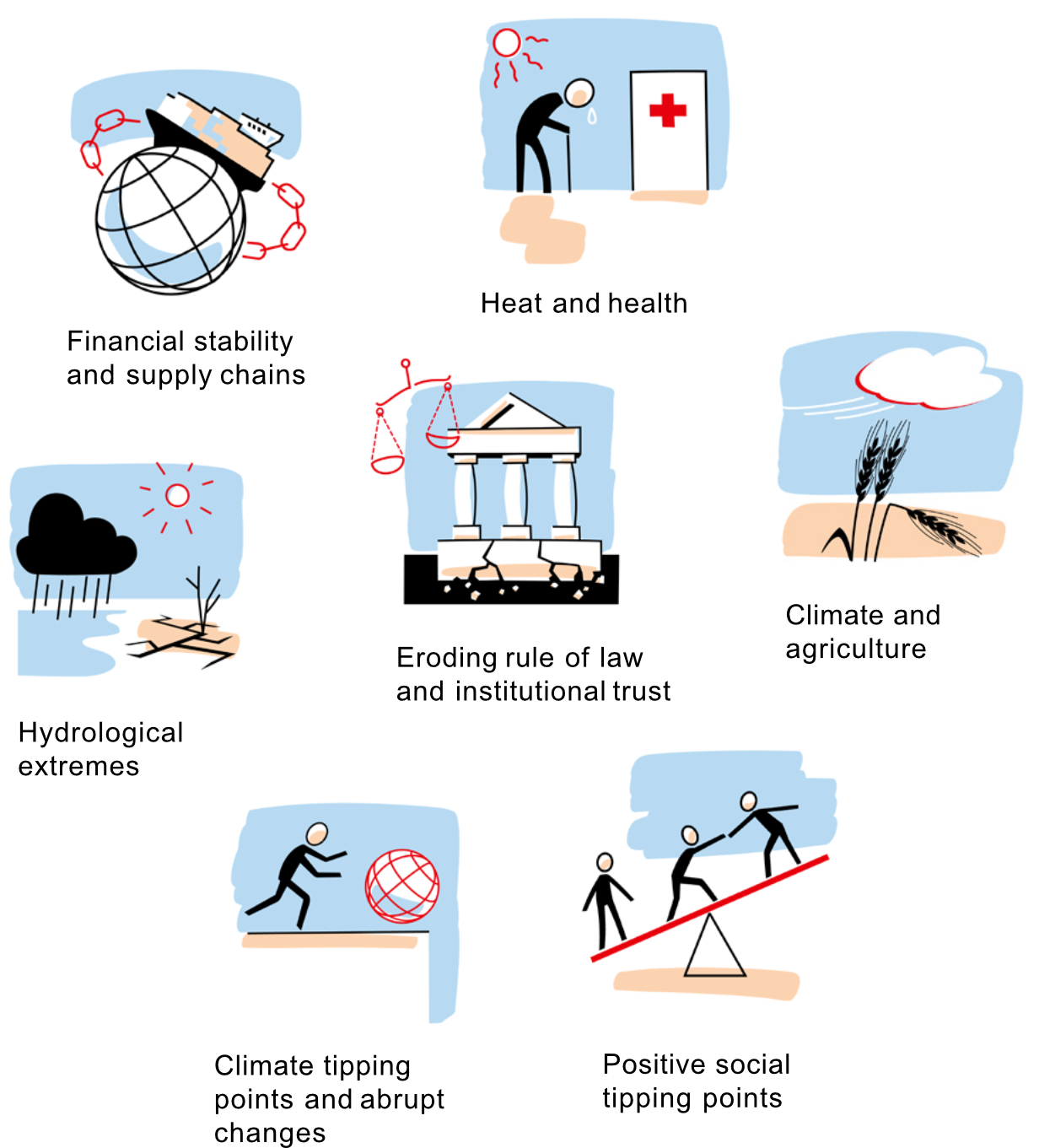 NCCR CLIM+ storylines in pictograms
With its unprecedented scale and scope of collaborative climate research, NCCR CLIM+ represents a unique and timely effort to foster societal resilience towards climate extremes. By delivering learnings, solutions, and structures that last, NCCR CLIM+ will make a difference not only for research, but for society at large.
People
Directorate
Co-director ETH Zurich: Prof. Sonia I. SeneviratneCo-director Uni Bern: Prof. Karin Ingold
Deputy Co-director ETH Zurich: Prof. David N. Bresch
Deputy Co-director Uni Bern: Prof. Olivia Romppainen-Martius
Management
Executive Manager ETH Zurich: Petra SieberExecutive Manager Uni Bern: Lucas Oesch
Principal Investigators
Aklin Michaël, EPFL; Battiston Stefano, Ca’ Foscari/UZH; Beisbart Claus, UniBE/OCCR; Bening Catharina, ETHZ; Blattner Charlotte, UNIL; Bresch David N., ETHZ/MeteoSwiss; Brönnimann Stefan, UniBE/OCCR; Brosch Tobias, UniGE; Brunner Manuela, WSL-SLF/ETHZ/C2SM/CERC; Chavez-Demoulin Valérie, UNIL/ECCE; Croci-Maspoli Mischa, MeteoSwiss/C2SM; Domeisen Daniela, UNIL/ECCE; Engelke Sebastian, UniGE; Fischer Erich, ETHZ; Frölicher Thomas, UniBE; Ginsbourger David, UniBE/OCCR; Grams Christian, MeteoSwiss; Grêt-Regamey Adrienne, ETHZ; Gruber Nicolas, ETHZ; Hangartner Dominik, ETHZ; Hoefler Torsten, ETHZ/CSCS; Hoffmann Sabine, EAWAG; Holzkaemper Annelie, Agroscope; Huggel Christian, UZH; Ingold Karin, UniBE/EAWAG/OCCR; Jacobs Claus, UniBE; Keller Helen, UZH; Knutti Reto, ETHZ/C2SM; Kölbel Julian, HSG; Lehning Michael, WSL-SLF/EPFL; Nguyen Quynh, UniBE/WyssAcademy; Pohl Christian, ETHZ/TdLab; Prein Andreas, ETHZ/C2SM; Romppainen-Martius Olivia, UniBE/OCCR; Schäfer Mike, UZH; Schmidt Tobias, ETHZ; Schnadt Poberaj Christina, C2SM/ETHZ; Seneviratne Sonia I., ETHZ/C2SM; Stadelmann-Steffen Isabelle, UniBE; Trein Philipp, UNIL; VandeVondele Joost, CSCS/ETHZ; Varone Frédéric, UniGE; Vicedo-Cabrera Ana, UniBE/OCCR; Volpi Michele, SDSC/ETHZ; Mai Laura, UniBE; Zeng Jing, UZH; Ziegel Johanna, ETHZProject Partners
Gersbach Hans, KOF/ETHZ; Gudmundsson Lukas, ETHZ; Haug Sigve, DSL/UniBE; Hoffmann Volker, ETHZ; Koch, Erwan, UNIL/ECCE; Leippold Markus, UZH; Lohmann Ulrike, ETHZ; Schulthess Thomas, CSCS/ETHZ; Steffen Bjarne, ETHZ; Tretter Christiane, BeDSI/UniBEInternational Members of Advisory Board
Valentina Bosetti, Bocconi University, Italy; Chris Luebkeman, your2040; Valérie Masson-Delmotte, IPSL, France; Daniel Nohrstedt, Uppsala University, Sweden; Naomi Oreskes, Harvard, USA; Theodore Shepherd, U. Reading, UKNCCR CLIM+ Kick-Off Event | 10 September 2026
Public Part | 10:00–13:30
Audi Max (HG F30), ETH Zürich, Hauptgebäude, Rämistrasse 101, ZurichThe event will bring together researchers, partners, and stakeholders to discuss Climate Extremes and Resilience in Society, and the vision of the NCCR CLIM+ program to support Switzerland's transformation towards a more resilient and safer future. The program features keynote presentations and a panel discussion with leading experts, perspectives of the ETH Zurich and University of Bern Rectors, and a networking apéro. We look forward to welcoming you and celebrating the launch of NCCR CLIM+ together!
Internal part | 14:00-18:00
Green Floor and C 14, CHN Building, Universitätstrasse 16, ZurichOpen Positions
- Postdoctoral Position Interdisciplinary coordination of "Storylines of climate extreme events" at ETH Zurich: apply here